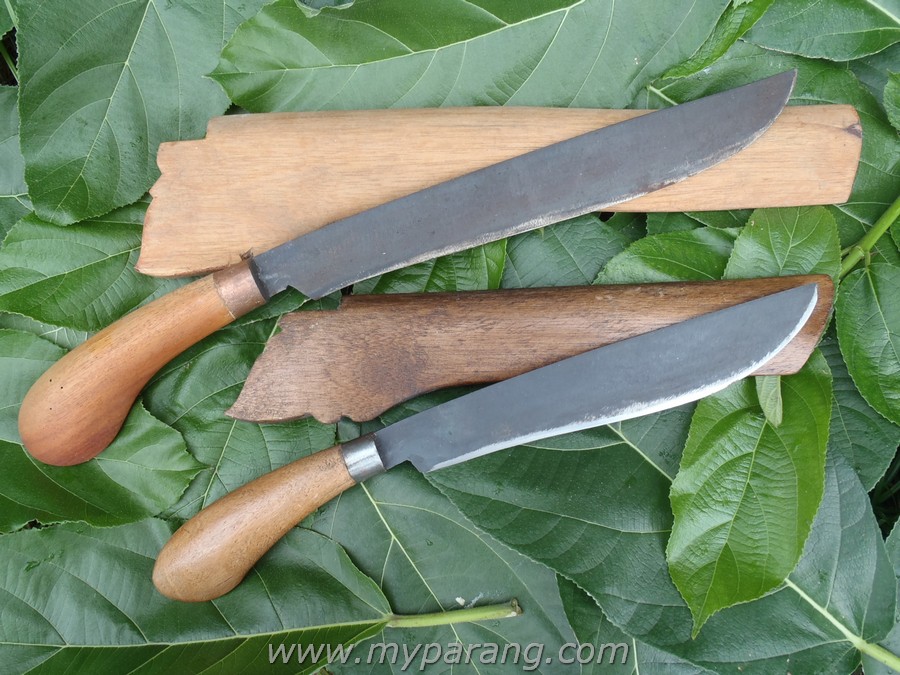
 Here are two golok Perak purchased from the Perak riverbank . I really like the clean and simple look of the Goloks. As you can see, the shape is pretty distinct, where the belly is not so pronounced as compared to a Golok made in say, Kelantan. The two Golok Perak above have never been used , as they are pretty light and more suitable for brush cleaning and light chopping. When I venture out in the jungle, I normally carry some heavier ones for chopping. The bigger one you see above is about 11 inches long ( the blade only ) while the smaller one below it is about 8 inches. Both are made of recycled leaf spring steel, or also known as 5160 steel. I am not completely sure, but the heat treat may have been done in oil. I do notice that parangs which have been quenched in oil will be much darker in colour and have an oily surface. This is based on my own observations only and should not be taken as a guide.
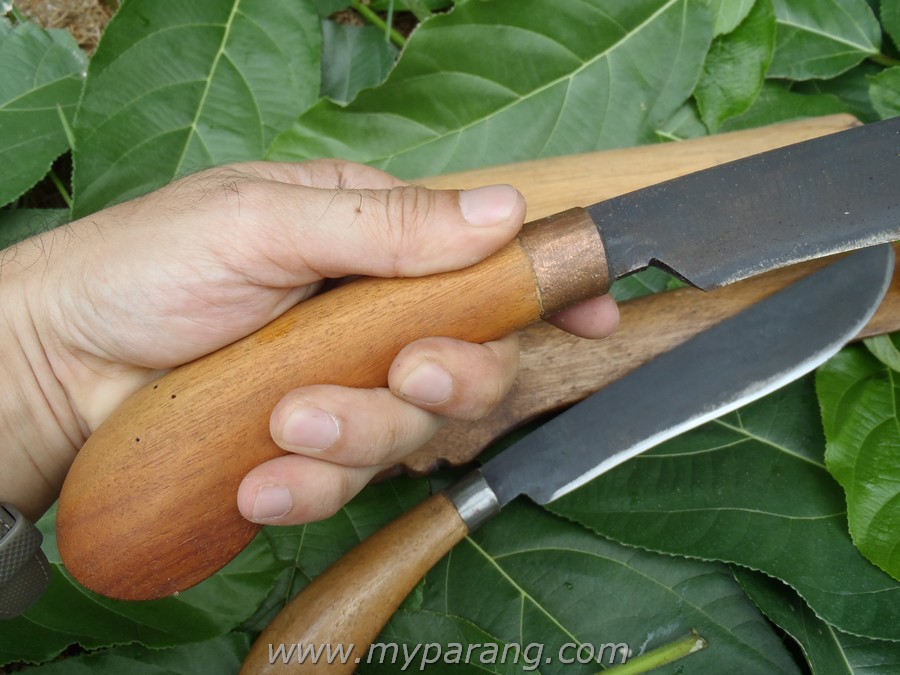
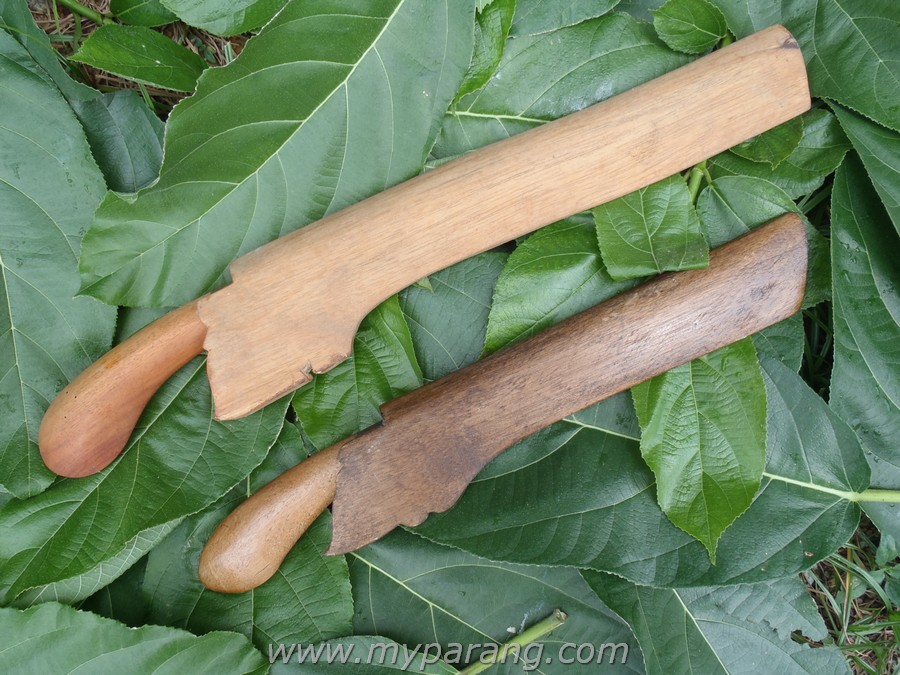 Here they are , sheathed in . The sheath is a 2-piece sheath and made of a very light wood. If I am not mistaken, the sheaths are made of Kapok wood. The sheath design is simple and does not have any rattan weave like those from East Malaysia or Borneo. As you can see , in the bottom sheath, it is slightly more difficult to draw this particular golok as there is a part of the sheath which protrudes up it’s a small overlook which can be easily corrected. The handles also are very simple in design but have a very very comfortable feel to it . Below is a picture of me holding the Golok Perak in my hand. The handle is made of a denser type of wood, but I am not sure of which type.
hello,
the blades are typically coated with an ash paste mix and then quenched fully with the spine down in perak. mostly in oil can be water too . . they are then tempered in the fire flame the tip is softer than the cutting edge..
because of this method they should not bend with heavy use unlike some water edge quenched knives with more soft spine.
it will flex more like a european knife.
the ash coating is to protect from scale during the heating process and then it can be rubbed off leaving a grey coloured blade underneath.
the are dunked spine down to stop edge cracking.
the straight blade shape makes it easy to do with a fully sharpened knife so only the edge need to be slightly polished and its ready to sell. no post hardening grinding is needed.
the sheath are made using only a knife and a saw.. the wood is soft but resists swelling from water and sticks tight to the knife.. if your knife has a rough fit you can rub the blades down with sand paper and then wax them a little and then try again and they should be very smooth fitting.
mostly this style is made in a village near kuala kangsar there is a village near the royal palace that makes them but theyer a bit pricey for what you get.
hi Perak,
Thank you for the comment and detailed explanation. I have yet to visit the Kuala Kangsar blacksmiths . They are well know as well