Category Archives: Types of parangs

MY Parang vs Budget Chandong Parang

my parang duku chandong vs the budget chandong parang
MY Parang Duku Chandong compared to the Budget Chandong parang

Recently we have come across some posts in certain knife forums asking why there is such a price difference between the MY Parang – parangs , compared to the previous Bidor made parangs. To answer that question, we will take two simillar parangs – the MY Parang Duku Chandong and the Budget Chandong parang and compare them side to side.

Outdoor Dynamics has been selling the Bidor parang for quite a few  years now, and they have had so many requests for wooden – handled parang. Hence, after many years of planning and thoughts, the brand ” MY Parang” was borne . All the goodness of the Bidor parang blades, but with a wooden handle.

my parang bidor stamp
The blade is cleaned up , removing the black coating caused by forging and heat treat.

Yes, the blades / blanks are sourced from the same blacksmith in Bidor , but for the case of MY Parang , we take a few more steps to clean the blade up. What we mean by clean the blade is to remove the protective shellac and black coating left after the forging and hardening process. With the black coating removed, we can now see the beauty of a hand forged blade. The forge marks are left intact and not ground smooth . We believe it gives a natural and unique look to the parang. One of the signs of authenticity .

my parang polished spine s
polished myparang spine comparison

 We also clean up the spine, which comes from the factory all black and wobbly. We smoothen it down and give it a sharper shoulder so our users can use a fire steel on the spine. As you can see from the picture above, the polished spine looks much better and takes away the roughness from the factory.

budget chandong parang handle vs wooden parang handle
The wooden handle vs the plastic handle

Now to the handle . The budget Chandong parang has a plastic handle which comes from the factory. These plastic handles are not the best, but they are cheap and they do work. Some feedback we have received is that they are slippery or feel like holding a candle. We believe the plastic used to make the handle is not virgin material but consists of quite a large percentage of recycled plastics, hence the waxy feeling. The plastic handle of the budget chandong parang  is fixed by heating the tang of the blade and sticking it in the handle while it is still hot. Once the plastic has hardened, the tang is pinned using a small wire / pin.

The MY Parang handle is made from Beech –  eco wood sourced from Croatia. What we mean by eco wood is that the wood comes from a farm ( planted and renewable ), and not taken off the wild , like many local hardwoods are. Being an imported wood, it does cost a huge amount more to import, cut and shape to a handle, compared to a locally made plastic handle. While the plastic handle comes out the mold ready to be used, the wooden handle still needs work. We still need to do some minor adjustments such as – to fit the collar , install the tang and to dye it a darker colour. We also add in in a much thicker 3.5mm brass pin under the collar to give the parang additional security.

my parang handle 2
wooden vs plastic parang handle
my parang handle 6
wooden parang handle length
my parang handle 5
plastic handle length

The MY Parang wooden handle also has a slightly different shape to it. The Budget Chandong parang handle is slightly shorter and the butt curves down more abruptly. This makes it slightly less comfortable if you are holding the butt of the handle for power cuts. The MY parang   wooden handle has a gentler curve and is much more comfortable to hold , either choking up or extended for power cuts. You can see this clearly from the pictures above.

my parang handle 4
MY Parang handle length
my parang handle 3
MY parang handle width ( it is slightly more than 1″ – the camera makes it look like its less )

Above shows some measurements for the wooden MY parang handles. They were made slightly larger to accommodate larger hands, but they work very well even for those with smaller hands.

 There is quite a huge difference in the Budget Chandong parang compared to the MY parang . As you can see, the Budget chandong parang is basically sold as it arrives from the factory. The only extra work we do is stick a price tag on it. With MY Parang , it goes through a much longer process and is made with using higher quality material – Copper collar, brass pin, dyed wooden handled and industrial strength epoxy to hold it all together. MY parang products are also packed in a presentable box .

We hope this post will enlighten those who have asked.

A look at current MY Parang products

my parang
The types of parang and goloks MY Parang produces

Currently MY Parang products consists  two types of parangs – the Duku Chandong and the Golok. The Duku Chandong comes in three variations – the 12 inch, the 10 inch and the 12 inch heavy . As for the Golok, they come in two variations – the 125 and the 135. Below we look at them more closely , in fact this post will be more pictures than words. Enjoy!

General overview of MY Parang Products

my parang forge marks
Real forge marks , not stamped by machines
my parang blade forge marks
Each blade is different and there will never be two of the same
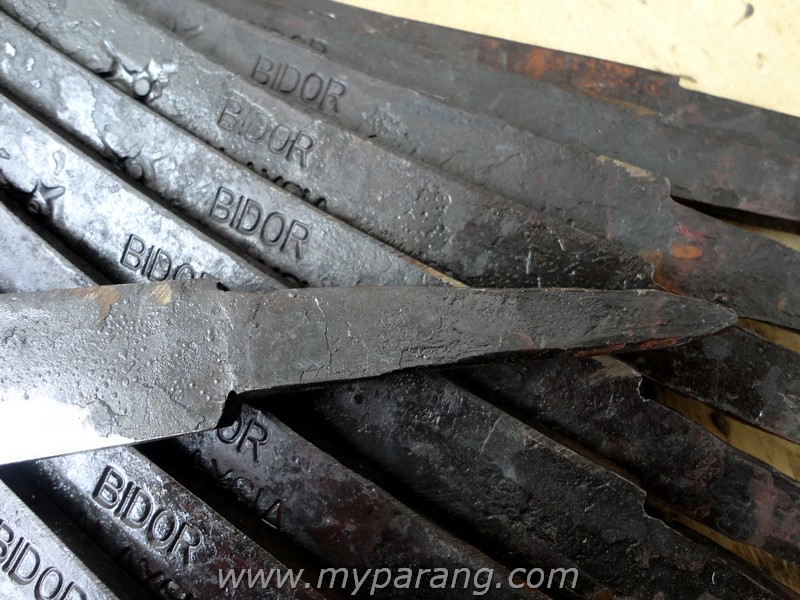
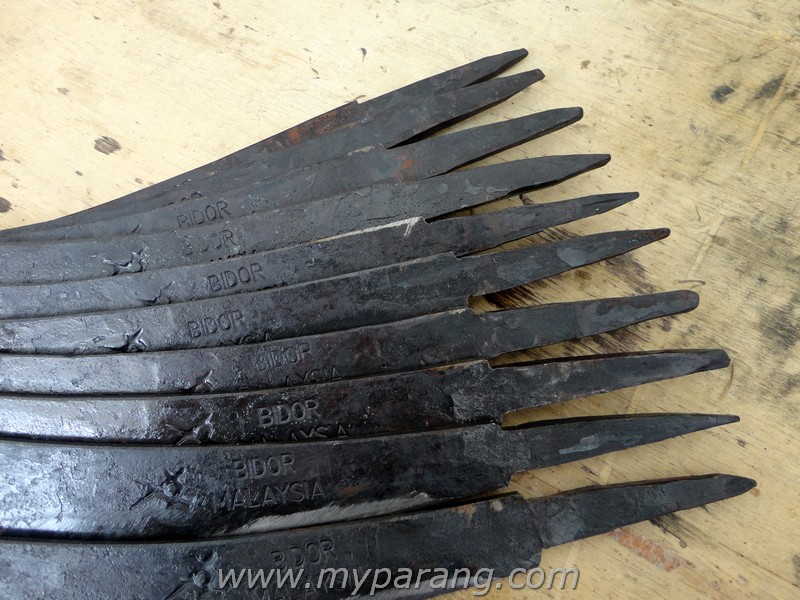
my parang genuine bidor stamp
The real Bidor stamps , the sign of authenticity

The blade which is made of 5160 high carbon steel or commonly know as leaf spring steel and has real forge marks not those fake machine stamped  one you see in other commercial brands. The blades are hand forged  and each one is unique.

my parang wooden handleThe handle is made of Eco – wood sourced from Croatia. They are farmed Beech wood and are a renewable resource. The handle shape is of a simple and traditional design . It has been proven to be a very comfortable handle and will not give you any blisters despite chopping away for hours.

my parang handle width
The width of the handle is approximately 1″ , it looks smaller it the photo due to the camera wide angle lens.
my parang handle length
Overall length of the handle is about 6.5″ , large enough for most hands.

We have made the handle slightly longer to accommodate large hands. The handle design enables various grips comfortably , from choking up to the blade, to holding the handle way back . Various handle position enables different cutting tasks. Unlike some modern parangs, their handle has guards and choils which hinder this natural use of the handle.

my parang sanded spine
The spine is sanded square
my parang spine thickness
Spine thickness near the handle – about 7/32″ or 5mm
my parang distal taper
Spine thickness at the tip – 1/8″ or about 3mm

Another great feature of MY Parang products is that all the blades has a distal taper. This improves the balance of the parang, making it very lively and quick in the hand, without sacrificing chopping power. A distal taper is very difficult and expensive to achieve with a factory made knife. The spines are also all cleaned up and feature a brush finish. Striking a ferro rod with the spine should not be a problem.

my parang handle
Copper rings improves the look of MY parang products

The copper ring / bolster is aesthetically appealing and compliments the whole look of the parang. It serves a beautiful and functional way of transition between the handle and blade. Besides looks, it also serves to strengthen the front of the handle, where most of the shock happens during chopping. Under the copper bolster we have also inserted a brass pin across the handle and stick tang. This is to ensure that the blade will never some out in any circumstances. You will have to brake the handle to cause the blade to come out , something which we believe would be impossible with normal use.

my parang choke upMost if not all genuine  parangs have an unsharpened blade section  a few inches after the handle. This is to enable the hand to choke up further into the blade for more delicate cutting tasks. This feature can also be seen on the Duku Chandong.

my parang epoxy
Tang and bolster is glued using industrial strength slow setting epoxy

To securely fasten the tang, handle and Copper bolster, we use industrial strength two part epoxy. We do not skimp on this as it is one of the most crucial parts of the parang. We have seen newspaper , hot glue, molten plastic , superglue and many other suspect ways of holding the tang in the handle, but nothing beats an epoxy specially formulated to bond wood and steel.

MY Parang Duku Chandong

The Duku Chandong or sometimes referred to  as the ” Ray Mears ” parang originates from East Malaysia or as some people call, Borneo. It is a very common blade shape there . The Duku Chandong is a general purpose parang and it is very common to see people in Borneo using it in their everyday lives.

my parang chandong
MY Parang Duku Chandong – Top is the 12″, middle is the 12″ heavy , and the bottom is the 10″

The main character of the knife is the sheeps-foot tip and how the handle is lifted up . While the sheeps-foot tip is very strong and suitable for prying, the upward handle causes the blade to arrive first followed by the knuckles. This is a great feature if you are cutting near the ground or near a solid object such as a big tree trunk , as it keeps your knuckles away and prevents if from getting bashed.
The blade also has a slightly upward curve, which produces a slicing cut. This type of cut is very effective at cutting small plants and shrubs.

MY Parang produces three different variations of the Chandong, the 12″ , the 10″ and the 12″ Heavy. The 12″ is the most common size and is often referred to as the ” go to” size. It offers good reach while not being too long nor too short. if you are looking for the best all rounder tool, this is the one to pick. The 10″ version is lighter and shorter. It is best suited for small tasks or when weight is a major issue. Despite it’s small size, it can still chop extremely well. As for the 12″ Heavy version, it is aimed more to those who will be using it to chop more than other tasks. Being made of thicker steel, the overall weight is considerably more and therefore is a beast at chopping. Heavy parangs do have a down side though, one is their overall weight and second, your arms get tired faster when using it. If you are going to use the parang throughout the day, we strongly get the 12″ version.

my parang heavy vs normal
The difference in spine thickness between the Chandong 12 ” and the Chandong 12″ Heavy.
my parang heavy comparison
Closer look of the spine thickness

The above picture shows the spine thickness difference between the 12″ Duku Chandong vs the 12″ Duku Chandong heavy. You can clearly see the difference in spine thickness as well as the distal taper .

MY Parang Golok

my parang golok
The MY Parang Golok 125 and 135

While the Chandong is common in East Malaysia , the Golok is a very common design in West Malaysia.  Goloks can be seen commonly sold in hardware and certain convenience stores throughout Peninsular Malaysia. It is common to have a golok or two at home, especially if you live in the suburbs. They are general use tools , from skinning animals to cutting weeds to opening coconuts.

my parang golok forge marks
The tell – tale tip of the Golok

Goloks can be characterized by the pointed tip as can be seen above. The tip is pretty strong and the point makes it easy to dig and pry holes. Due to the shape of the tip, it is not really suitable to chop with it, compared to the sheeps foot tip. Goloks also have a prominent belly which can sometimes be a problem with sharpening, especially if your sharpening stone is wide. The belly

The larger Golok, the 135 is a heftier parang which is more suitable for chopping and rough work. The smaller 125 is suitable for lighter work and is considerably shorter and lighter. We have no idea what the 135 and 125 mean, but they seem to be a universal “model” throughout Malaysia , ie a 125 golok bought in different states will be the same design and same length / weight.


Stick tang parangs

It’s been some time since our last post as things have been busy at the workshop. All good stuff!Parang tang 05This post will be about stick tang parangs. We get a lot of inquiries regarding full tang parangs, but at the moment we do not make them.  Most people ask for full tang parangs because they believe that the stick tang parang is a lot weaker and dangerous compared to a full tang parang. This may be a myth? Read on .

Parang tang 03The stick tangs parangs before the handle is installed

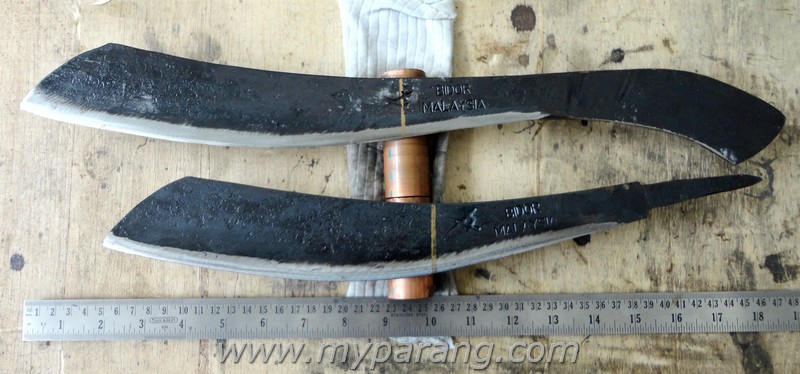
The traditional parang has remained unchanged for hundreds of years, and they have been stick tang all this while. For a design that has been that way for so long, there must be something right . The stick tang parang construction actually has a few benefits such as bringing the effective weight forward, hence a more powerful  chop, while reducing the overall parang weight. The stick tang also uses less steel  , and the handle, if it comes loose, can be easily repaired. Yes, sometimes the handle does comes loose , and if you are a regular parang user, you can immediately notice this when you do some chopping.
Parang tang 10This picture shows the stick tang parang is more weight – forward compared to the full tang parang. The gold coloured lines are the midpoint ( tip to tip ) .

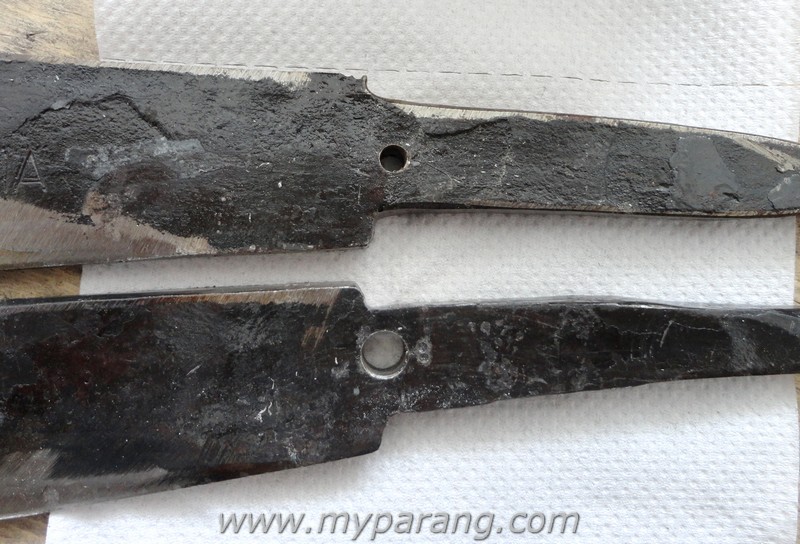
Some people add pins to their stick tang parangs ( all parangs from  myparang  have a brass pin under the collar ) to prevent the blade and handle from coming apart, and that’s acceptable. The pin does not help to strengthen the parang in any way, nor does it effect it’s balance. It’s function is to prevent the blade from dropping ( or more dramatic – flying out ) out . With that said, one should keep that clearly in mind. A bigger pin will NOT make your parang safer, actually it will weaken it a lot. By drilling a large hole, you are actually removing metal from the already thin stick tang. Too little metal on the tang will result in sudden  failure and potentially injure someone.

Some people add two pins, which is really not necessary. One pin is safe enough, two pins is overkill and not needed.

Parang tang 02The top is the hole size we use for our brass pin which is 3.5mm thick, while the hole below has a 6.0 mm hole drilled through it to show the effects of adding a larger pin. Notice how much metal is left in the lower parang stick tang.

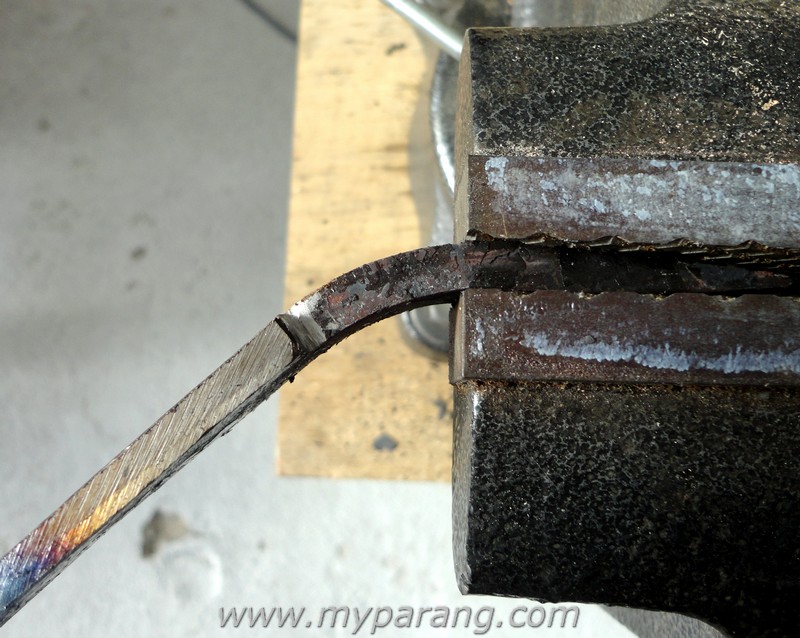
Some have raised their concerns on the “smallness ” of the tangs and are worried that the stick tang parang will break at the tang. This is probably true if the whole parang blade is hardened. The common parangs you see in Malaysia and also the ones from Myparang do not have a hardened tang. Only the cutting edge of the parang is hardened, not the spine and not the tang. This can only be achieved by hand – hardening the blades , machines cannot replicate this. So, while a modern factory made machete “might” break at the tang, a traditionally made parang with a stick tang will not. I have checked with the Bidor maker, and he himself after being in the industry for 50+ years, has never seen one if his stick tang parangs break at the tang.

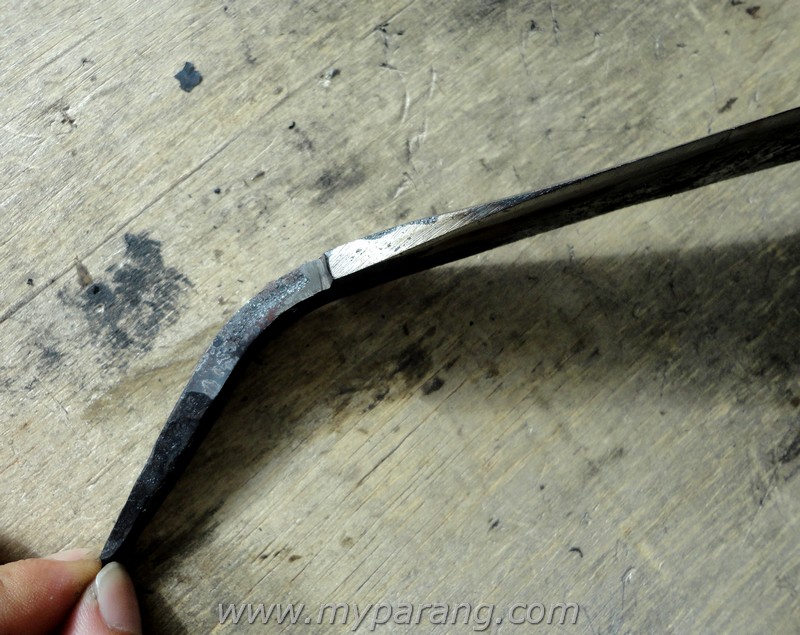
Parang tang 13 Bending the tang , we tried, but it will not break!

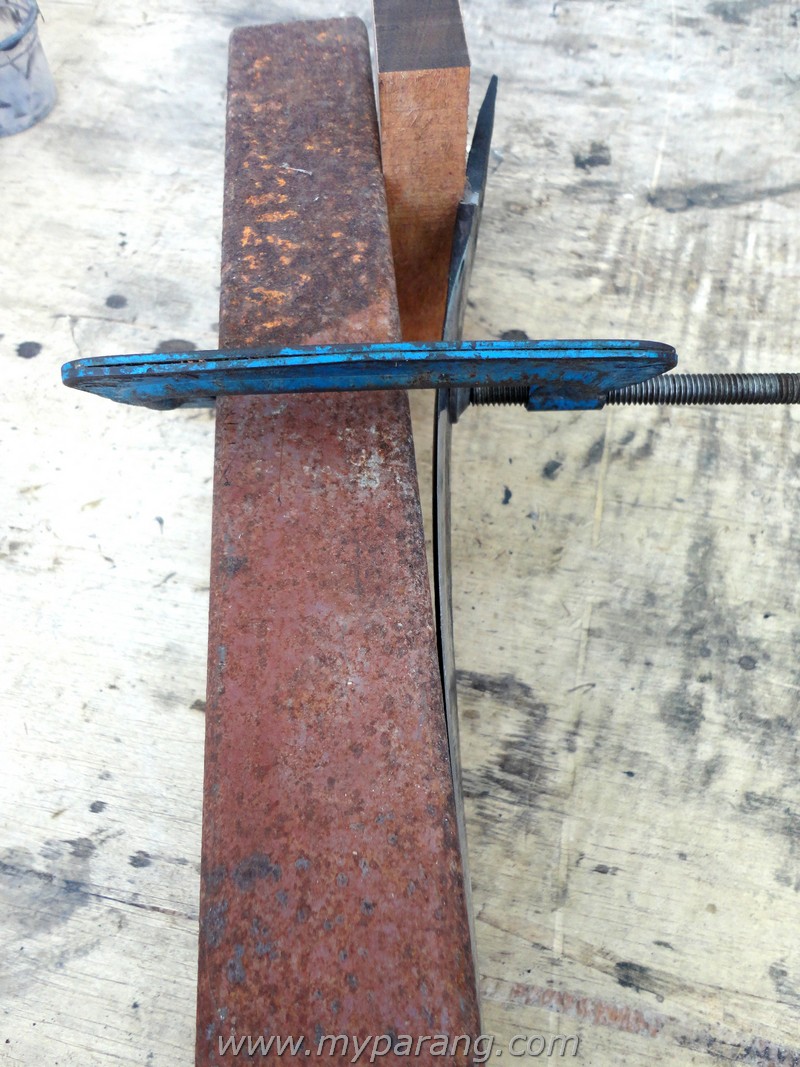
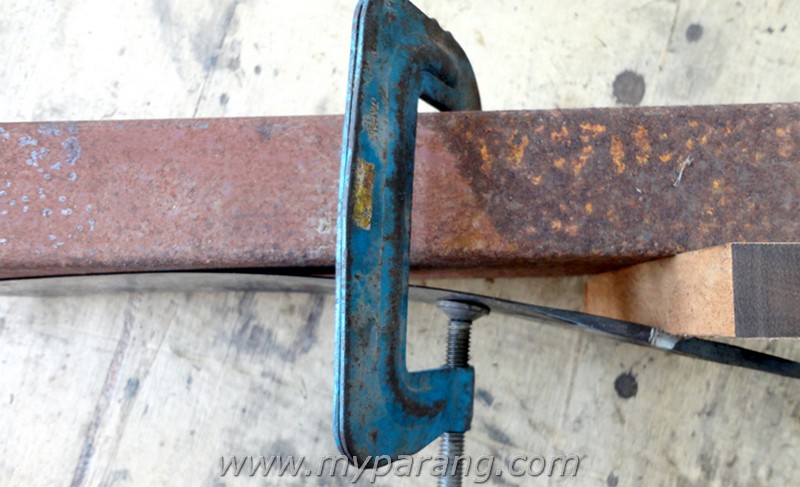
Parang tang 15Here it is out of the vice. No, we’re not turning this one into a parang 🙂 parang tang a 04 parang tang a 02 This is how much the blades can bend, actually it can bend more, but our G-clamp was at it’s limit already.

Having see the pictures, I hope it helps to illustrate the point that stick tang parangs are safe. Yes, the handle may come out loose. We at myparang try and avoid that by making sure the tangs are ground to bare metal, cleaned with solvents and use industrial strengthen epoxy to bind it all together. Then we add a 3.5mm brass pin as a safety precaution.

We understand that axes do not come pinned in any part of the world , and nobody pins axe heads. Interesting enough, as the axe heads are held by friction only in the hafts ! That’s some food for thought folks!

Common Malaysian Parangs

Common  Malaysian Parangs

other bidor parangs 1Parangs and Goloks have been in our culture for ages, so it’s not surprising to have many skilled parang and golok makers in Malaysia. It is a thriving cottage industry and I must say there are some really good craftsmen out there. Each of the different states in Malaysia will have at least a dozen makers, from part time hobbyist to full time craftsmen.

Some makers only concentrate on making the blades, while some specialize in making wooden sheaths and handles only. Most do both, as it is a convenience to their customers. Some people do buy and create in stages, ie they may commission a parang or keris blade this year, and when they have some excess funds, they will then make the sheath and handle. The price of custom parangs vary widely, from rm 50.00 for a rough and bare one to rm 500.00 and above for more exotic ones using special steel and fancier wood.

While these craftsmen are many , so are blacksmiths who make agricultural tools. A lot if not all the tools used in palm and rubber plantations are sourced locally . They are much cheaper and easier to access. These blacksmiths who make agricultural tools vary in size, some are smaller backyard ones, while some are factories on their own , and can churn out hundreds of pieces every week.

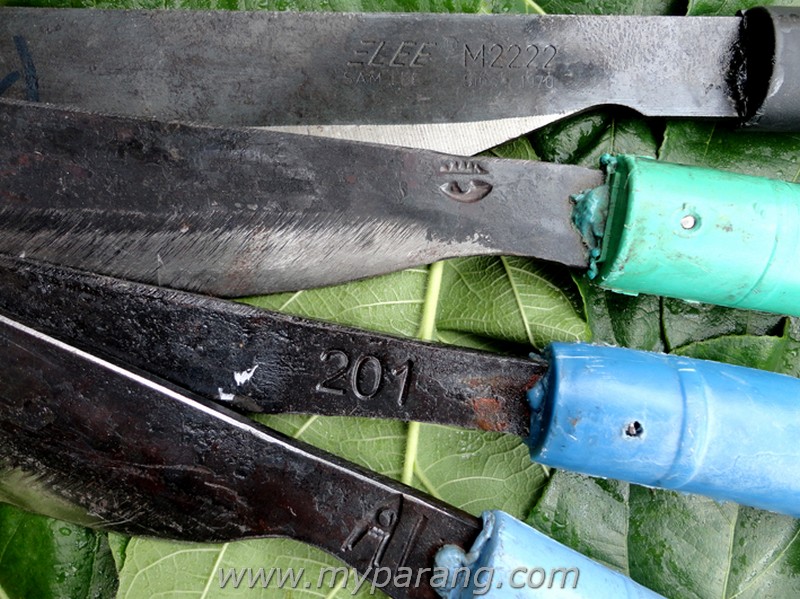
Common Malaysian parangs which you can find are of different brands like A1, Cap Mata ( eye brand ) , 201  and Sam Lee. There are more, and I will add them in once I have found them. Most of them are similar to the Bidor made ones, but one stands out quite a bit.

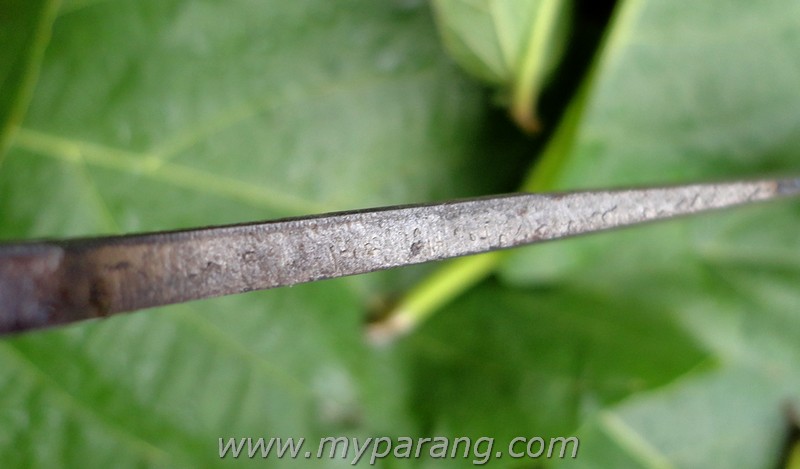
If you look closely at the one made by Sam Lee, it looks like it has been made in a factory. Like super mass produced. The blade is stamped off a large sheet of metal , as you can see the sheer marks on the side of the blade.

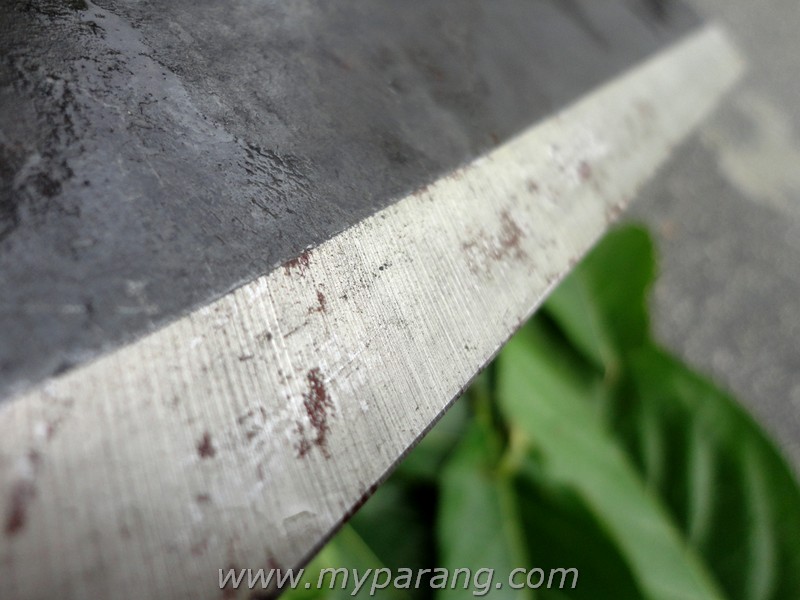
sam lee parang spineYou can also see the edge grinding is probably made by a machine as the grinding marks are very evenly spaced and even. They even have a micro bevel at the edge.

sam lee parang 2It would be nice to check their factory out one day, but I will need to do some research as the parangs they make do not come with any address or contact no.

More parangs to come, so stay tuned!

FAKE Bidor Parangs


Fake Bidor parangs

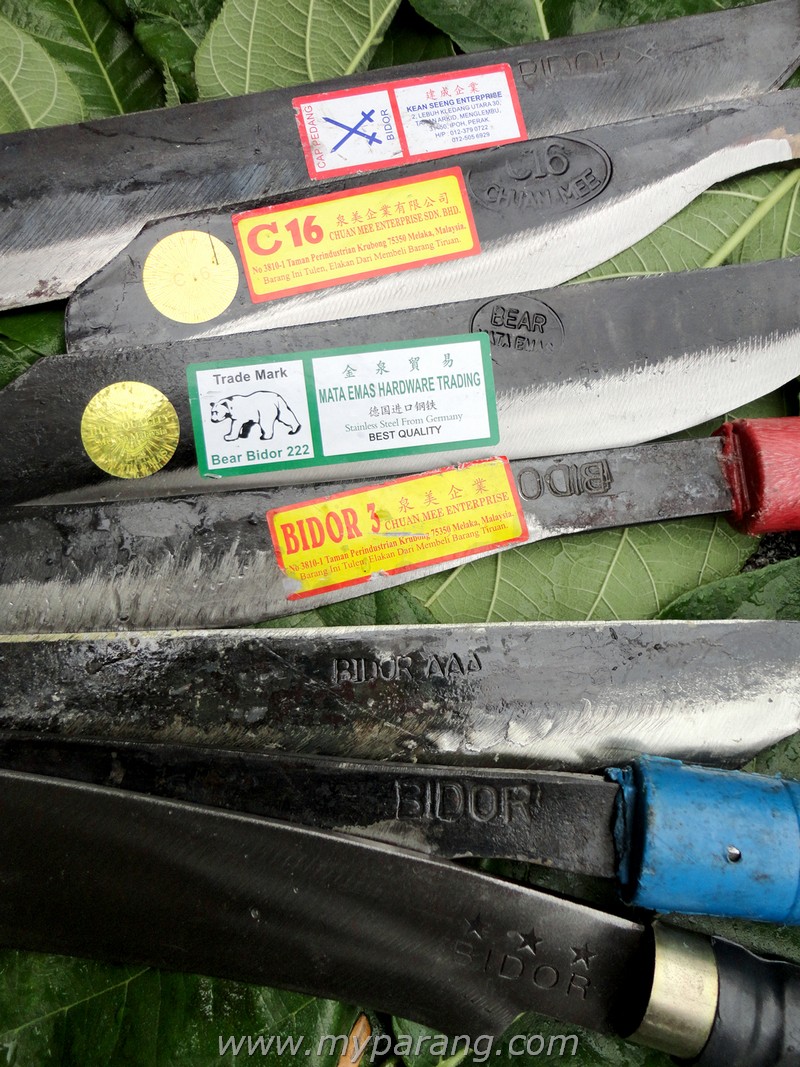
fake bidor parang 3 Yes, they are out there , beware. Some say imitation is another form of flattery , but unless you know it is a fake, you can be easily be cheated when buying a parang. Fake Bidor parangs should be avoidedas they may be made of inferior quality steel, I’ve even heard of some using rebar ( construction steel ) and their heat treatment may be of suspect as well. If you buy a fake Bidor Parang, you may end up with a piece of useless metal.

Bidor Balcksmith workshop                                    The genuine Bidor Blacksmith workshop

When I first went to the Bidor Blacksmith many years back, Ah Pin mentioned to me that there are many fake Bidor parangs out there. Initially I thought not much out of it, until recently when I went around looking for various types of Parangs sold here in Malaysia. Whenever I had the time, I would drop by a hardware shop and get whatever parang brands I could find. And much to my surprise , many have the word or name “BIDOR” stamped  or stuck on them , despite not being made in Bidor.

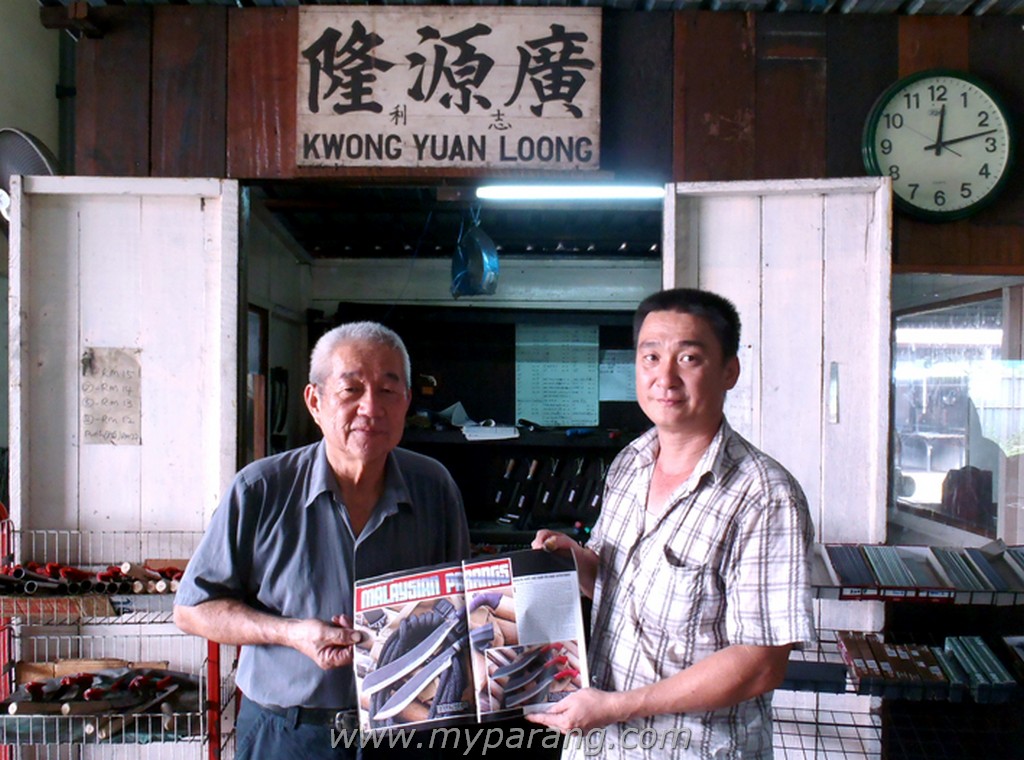
bidor BlackmisthsMr. Chin Pin Yon ( Left )  and His Son in law – Foo Yong Ming ( right ) with the magazine article

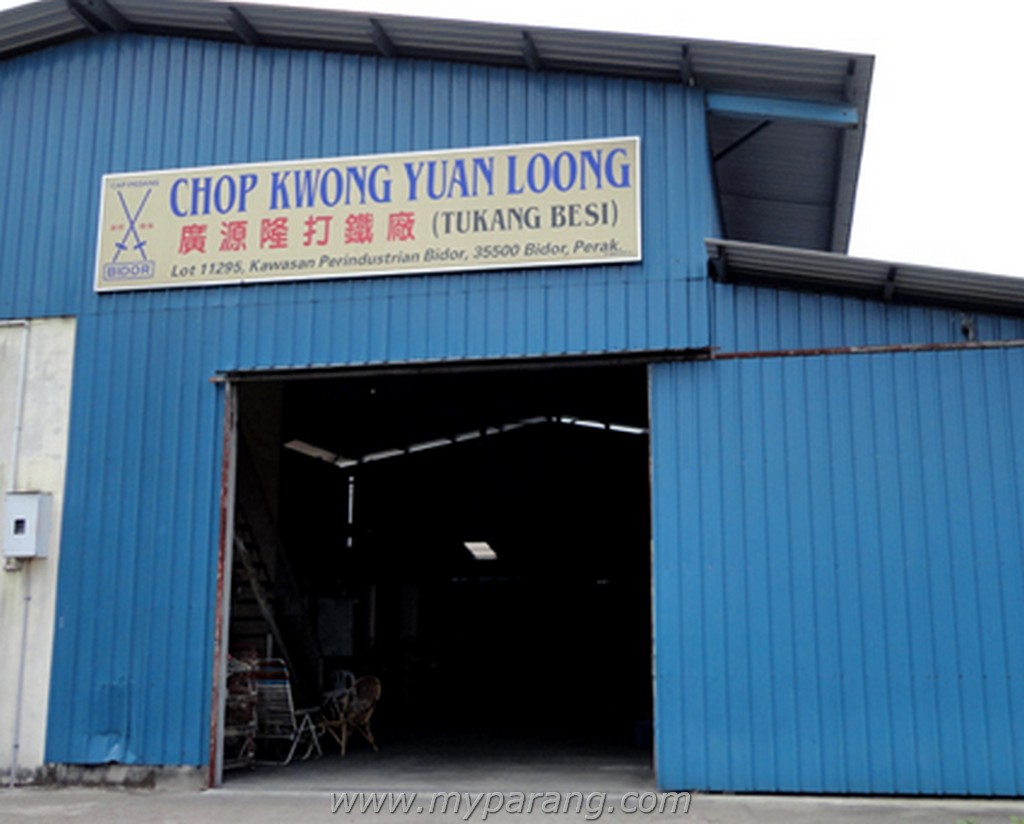
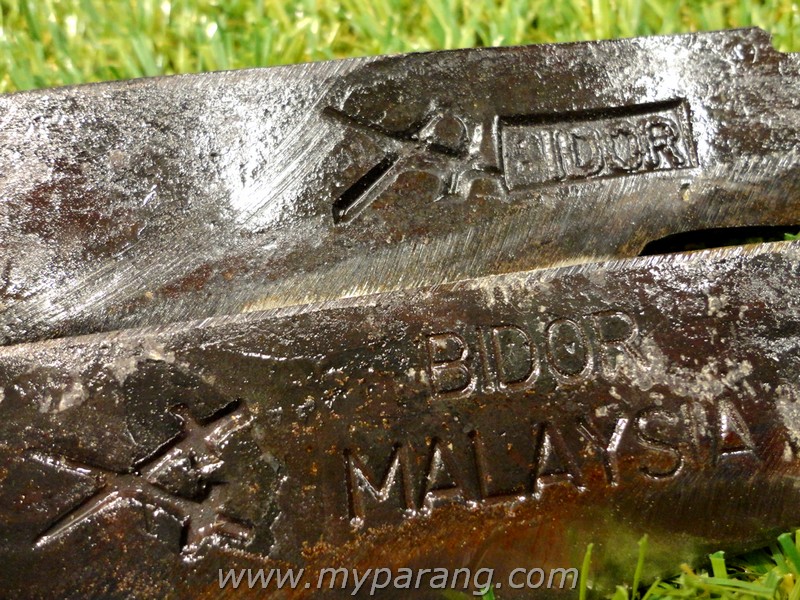
As far as I know, there are two parang blacksmiths in Bidor, and they are just about 100 meters from each other. One is Chop Kwong Yuan Loong and the other newer one is Mak Heng Seng . There may be a few other small traditional makers around, but I have not seen them.  Chop Kwong Yuan Loong is the authentic Bidor parang maker and they have been featured in the Tactical Knifes Magazine ( July 2012 issue ) , as you can see in the picture above. Outdoor Dynamics Sdn Bhd gets their parangs from Chop Kwong Yuan Loong . Outdoor Dynamics also supplies parangs to Machetespecialist.com , so yes, they do sell authentic parangs from Bidor. As for the other Blacksmith in Bidor, we did attempt to meet them some time back, but they were  cold and uncooperative.    authentic bidor parang stampAuthentic Bidor Parang Stamps – The Crossed swords and BIDOR are their trademark. The Crossed Swords and BIDOR MALAYSIA are these made specially for Outdoor Dynamics.

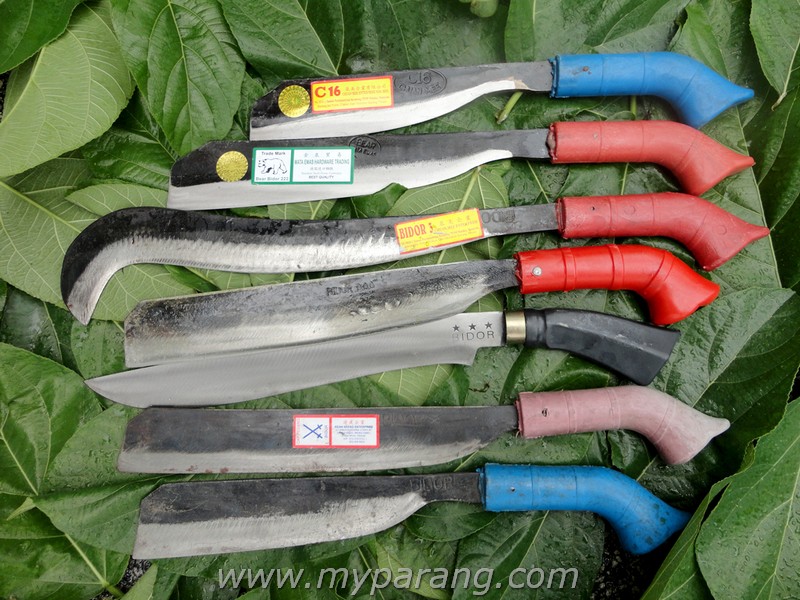
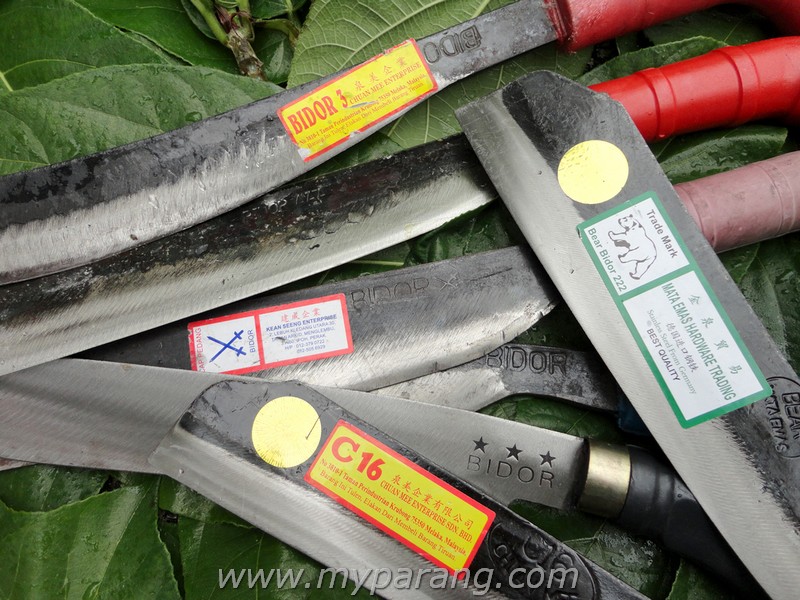
Bidor is a town in Perak, Malaysia , so if the parangs are not made there , it would be wrong to put the name “Bidor” on it. Imagine a knife with the word “Seki City” but made in Iwata Japan. That would be misleading and not right. Some red flags that these are fake Bidor Parangs  are:  Stamped BIDOR , but the factory address is in another state , has the Bidor Stamp, but use a different Logo , ie instead of the crossed swords, they have the picture of a Bear or 3 stars. One even copied the sticker but had a different address ( in another state of course ) and another just stamped “BIDOR” without the crossed swords.

Below are some pictures of the fake Bidor parangs. I am not sure of the quality , but if they need to copy someone else, then that from the start is not good.

fake bidor parang 1fake bidor parang 2 So if you are looking for authentic Bidor Parangs, keep and eye for the red flags. In my opinion, a brandless parang is better then a fake Bidor parang. To be sure, buy your parangs from a reputable dealer.